|
All the signals are goWhy it is almost hereWhy it is inevitableBEGINNING OF THE END!Writing
began on this book in mid-July 2001. On the morning of September 11, as it
was being packed for mailing to the printing house, a staff member rushed
in with the news that one, and then another, of the twin Trade Center
towers had been struck by terrorists. We had no idea these specific
incidents would occur. This is a day of infamy for our great nation,—yet
this book was written to provide a wide-ranging warning of this and
similar dangers. The information it contains is needed by our people more
than ever before. We are facing a stupendous crisis, and it will deepen.- Harvestime
Books About
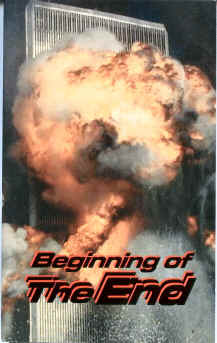
the front cover: A view of part of the
terrible tragedy that occurred in New York City on September 11. At 9:03
on the morning of September 11, 17 minutes after the earlier impact, a
second Boeing 767 was turned into a flying jet-fuel bomb. United Airlines
Flight 175, hijacked en route from Boston to Los Angeles with 65
passengers aboard, struck
floors 80 to 86 of the 110 story, 1,362-foot South World Trade Center.
Fifty-seven minutes later, it was the first of the two towers to collapse
In July 1946, the United States tested two fission
(plutonium) bombs of 20-kiloton power at Bikini Atoll in the Marshall
Islands. These tests were made to determine the effects of nuclear weapons
on U.S. warships and military equipment. Far more powerful bombs were
developed later. At the present time, there are over 50,000 nuclear bombs
stockpiled in various places around the world. “In
the remaining decades of this century, mankind’s problems will be
increasingly complex in detail and global in scope . . Never before have
so many people faced so many problems of such great complexity. Any
attempt to isolate issues and apply short-range remedies will continue to
fail by reason of the growing interdependency of all vital processes on
this planet.”—Ervin Laszlo, ed, The World System, p. v. “Are we racing to the brink of an abyss or are we just gathering speed for a takeoff to a wonderful future? The crystal ball is clouded; the human condition baffles all morality because it is both unprecedented and almost beyond understanding.”—E.O. Wilson, well-known biologist, “Is Humanity Suicidal?” The New York Times Magazine, May 30, 1993, p. 27. FORWARD CHAPTER
ONE CHAPTER
TWO CHAPTER
THREE CHAPTER
F CHAPTER FIVE - WHEN MEN DEFY GOD CHAPTER SIX - THE MARK OF THE BEAST CHAPTER SEVEN - QUESTIONS AND ANSWERS APPENDIX
1 - BIBLE
STUDY
APPENDIX
2 - WHY
THE REBELLION OUR 21st CENTURY CRISIS At
the beginning of the 20th century, people had great hopes for the future.
But the horrors of World War I shattered them. Then came the global misery
of World War II, and 100 million dead or disabled. And
with it came the atomic bomb. It was a beautiful morning with not a cloud in the sky. The date was August 6, 1945, the time 8:00 a.m. A single plane was in the sky. Then its bomb-bay doors opened. When
the bomb reached 1850 feet, a radar echo set off an ordinary explosion
inside. This drove a wedge of U-235 into a larger piece of U-235, setting
off a blast with the force of 13,000 tons [11,794 mt] of TNT. As a result,
more than 4½ square miles [11.7 km2]
of the city were destroyed. The “Little Boy” atomic bomb
exploded only 800 feet from on-target and essentially destroyed the city.
Over 92,000 persons were dead or missing. That
explosion changed the world. Never again would life be the same. “Since 1945, it began to be technologically feasible to end life on this planet.”—Michael Grosso, “Analyzing the Future,” in Isaac Asimov, ed., Living in the Future (1985), p. 18. Why
did we seek to uncover that last, that deepest, secret? But now it is done
and we stand aghast at what crazed men can now do to the rest of us. “Man has survived, thitherto, through ignorance. Can he continue to survive now that the useful degree of ignorance is lost?”—Bertrand Russell, Has Man a Future? historian and philosopher (1961), p. 69. Then
came the 43-year nuclear arms race between the United States and the
Soviet Union. For decades, there was a massive bipolar face-off between
the Soviet Union and America, and the rest of the world quietly sat back
and nervously watched. But then, when the Soviet Union broke apart in 1989, everything changed again. Over a dozen smaller nations began preparing for war against one another—or against us. Nations
once again arming,—but this time it is different. In the 1990s, we
entered upon a situation that has steadily grown almost unmanageable.
Now
there are too many actors in the drama, too many loose nukes, too many
individual terrorists. It is too easy to buy nuclear bombs, too easy to
make chemical and biological ones. The
leading scientists and intelligence experts of America tell us they long
for the days of the cold war, when things were peaceful! “In comparison to the present, in some ways it seems like the Cold War was a piece of cake.”—National Security Seminar, late 1990s, held at the U.S. Army War College, Carlisle, Pennsylvania. Make no mistake: The 1990s and beyond have hurled us into an increasingly dangerous world. Dr. Masoud, a U.S. defense expert, explains: “Those of us who spent our formative years during the halcyon days of the Cold War cannot escape feeling a modicum of nostalgia for the simplicity of that era. While the bipoloar structure of the Cold War nuclear confrontation ensured its stability, the chaos of the post-Cold War era has seen Third World ‘rogue’ states—like Iraq and North Korea—and possibly even terrorist elements become the newest players in an increasingly volatile nuclear game. Since everyone with an ax to grind appears to be trying to acquire nuclear materials, it seems inevitable that eventually someone, somewhere will succeed . . How does the West deter non-state terrorist actors with nuclear bombs and nothing to lose?”—Tarek E. Masoud, “Stealing the Fire: Nuclearizing the Third World,” Brown Journal of World Affairs, Winter/Spring 1997, pp. 17-18. The
entire world is becoming increasingly militarized, and many of the
belligerents are fanatics. As you
will learn in this book, we now live on the edge of a sudden military
attack which could destroy major cities,—an attack which need not
come from the skies. It can be brought in on trucks. Yet there are a
number of other, equally dangerous problems. This is the story of
what we are facing. Why it will come. And what you need to do to prepare
for it. COLLISION COURSE WITH DISASTER “We may have only a few decades until Doomsday.”—Carl Sagon, Cosmos, p. 328. In 1980, Avin Toffler, the well-known futurist, predicted that “the decades immediately ahead are likely to be filled with upheavals, turbulence, perhaps even widespread violence” (Alvin Toffler, The Third Wave, 1980, p. 12). Little
did Toffler imagine what was coming! The fall of East Germany and the
Soviet Union, at the end of the 1980s, hurled the planet into a level of
crisis living that was unimaginable in the preceding decades of relative
peace, when all the world sat back quietly and watched the Soviets and
Americans point guns at one another. It
is different now. “Currently we are behaving like insane passengers on a jet plane who are busy taking all the rivets and bolts out of the craft as it flies along.”—Tom Harper, Toronto Star, quoted in W.R. Goetz, Apocalypse Next: The End of Civilization as We Know It (1996), p. 28. “I think human life is threatened as never before in the history of this planet. Not by one peril, but by many. They are all working together, coming to a head about the same time. And the time lies very close to the year 2000. I am one of those scientists who find it hard to see how the human race is to bring itself much past the year 2000.”—Dr. George Walk, Chairman, Biology Department, Harvard University, Nobel prize winner, quoted in Goetz, p. 15. We
are now past 2000, but the reasons for coming catastrophe only intensify
with each passing month. “Political and economic trust will implode. Real hardship will beset the land, with severe distress that could involve questions of class, race, nation, and empire.”—William Strauss and Neil Howe, The Fourth Turning: An American Prophecy (1997), p. 6. Not on one or a few, but on many fronts, the situation is rapidly worsening. •
Ecological catastrophes—Global
warming, forests being destroyed, toxic waste, deserts enlarging, natural
resources disappearing, acid rain increasing, ozone holes widening, plant
and animal species vanishing, increasing accidents at nuclear power
plants. •
Hunger and famine—We
are experiencing “overpopulation beyond anything ever before experienced
on our planet, bringing in its wake hunger, famine, disease, and war” (William
Strauss and Neil Howe, the Fourth Turning: An American Prophecy,
1997, p. 6). •
Infectious disease—Poverty,
urban crowding, and international travel are spreading old diseases and
new ones everywhere. Smallpox and tuberculosis are again with us. Virulent
influenza and strange new diseases such as AIDS, Lyme disease, and hunta
virus. “It could mark the end of man. It will be an omnicidal Armageddon, destroying everything, leaving nothing.”—Ibid, p. 330. •
Weapons of mass destruction—This
situation is getting worse also. Not just the bomb, but powerful chemical
and biological weapons,—and not just from superpowers, but from
terrorist networks, rogue nations, and individuals. “This is the first age that’s paid much attention to the future. Which is a little ironic since we might not have one.”—Arthur C. Clarke, quoted in R.A. Swenson, Hurtling toward Oblivion (1999), p. 20. Whitehead
said, “It is the business of the future to be dangerous” (Alfred
North Whitehead, quoted in Edward Wenk, Jr., Tradeoffs: Imperatives of
Choice in a High-Tech World, 1986, p. 202). But that which the
world’s leading experts now say is just ahead of us is more than
dangerous; it is deadly. “The question for humanity is whether our species is capable of thinking and acting in its own interest to ensure its survival. Some scholars maintain that we hold within us an unconscious drive to self-destruct, which will eventually succeed.”—Melville C. Branch, “Why We Simulate Long-range Futures,” The Futurist, April 1998, p. 52. Professor Emeritus of Planning, University of Southern California. WHY CATASTROPHE CANNOT BE AVOIDED — 1 — BUILDING UP TO A CLIMAX The
entire world is rushing toward a dramatic climax. It will be swift,
powerful, and certain. In this chapter, we will explain several reasons
why it is inevitable. The
overwhelming majority of all the material goods we use in daily life today
have been developed within the generation in which we now live. “Until this century . . social change was so slow, that it would pass unnoticed in one person’s lifetime. That is no longer so. The rate of change has increased so much that our imagination can’t keep up. Indeed, says social psychologist Warren Bennis, the throttle has been pushed so far forward in recent years that no exaggeration, no hyperbole, no outrage can realistically describe the extent and pace of change . . In fact, only the exaggerations appear to be true.”—Alvin Toffler, Future Shock (1970), p. 22. On every hand, in every field, wherever we look or go—everything is increasing. In every technology, every aspect of living, every field of science and endeavor, we are experiencing dramatic increase, which, along with other factors, is leading us into an area of irreversible instability and danger. “The world of today . . is as different from the world in which I was born as that world was from Julius Caesar’s. I was born in the middle of human history, to date. Almost as much has happened since I was born as happened before.”—Alvin Toffler, Future Shock (1970), p. 13. •
People are living longer. At the time of birth, life expectancy throughout
the world was 27 years in the first century. In 1955, it was 48 years. By
1995, it was 65 years. It keeps increasing, with all the problems
attendant to this increase (Warren C. Robinson, “Global Population
Trends,” Resources, Spring 1998, Issue 131, pp. 6-9). •
The number of people on the planet keeps increasing. Every day, a
quarter-million more people are added to the world’s population. In 1800
there were one billion people in the world. In 1930, there were two
billion. Thirty years later in 1960, it was up to three billion. 15 years
later in 1975, four billion. Twelve years later in 1987, it was five
billion. Eleven more years and, in 1998, it was up to six billion. How
much further can we go? Wherever
else we turn, we see growth that is equally profound. More examples: •
U.S. paper consumption per capita tripled from 1940 to 1980, and tripled
again in the next ten years. It is now 1800 pounds per person per year (David
Shenk, Surviving the Information Glut, 1997, p. 2)! By the
mid-1980s, in America alone, every year 62,000 new book titles were being
printed. •
We use seven times as much water as we did in 1900, yet water supplies
continue to deplete and underground aquifers are gradually disappearing.
When they are gone, they cannot be replaced (Bill McKibben, Atlantic
Monthly, May 1998, pp. 55, 60). •
Global food production increases every year, but it cannot keep up with
the population. By using chemical fertilizers, we have dramatically
increased crop yields. But the experts tell us that those increases are
short-lived. Chemical fertilizers ultimately create an imbalance which
weakens the soil. •
In 1960, the average corporate president traveled
12,000 miles a year. Today he averages 112,000 miles a year (Jim
Taylor, et al., What Happens after What Comes Next, 1996, p. 151).
People are burning out. Go, go—more, get it done quicker, and then rush
around doing still more—when not caught in a traffic jam. •
In 1975, there were 3,000 international non-governmental organizations
(NGOs) in every field, from religion to sports to industry. Today there
are over 25,000. The world is going global! International contacts,
e-mail, travel, business; there are no limits (Alvin Toffler,
“Preparing for Conflict,” The Futurist, June/July 1998, pp. 26-29). •
We are now undergoing the most extensive and rapid urbanization the world
has ever seen. In 1850 only four cities on the face of the earth had a
population of one million or more. By 1900 the number had increased to 19.
Today there are over 170. World urban population is rocketing upward at a
rate of 8.5 percent per year. •
Half of all the energy consumed by man in the past 2,000 years has been
consumed in the last 60 years. •
In 1978, a grocery store had 11,000 products; today it has 30,000.
Everything is big, and rapidly becoming bigger. People want “super
stores” to shop in. •
The number of registered cars in the U.S. has increased fourfold since
1950. In a recent year, there were 100,000 more automobiles in
America than the year before. And every year that figure keeps growing. We
are literally rolling along,—and the gridlock on the streets becomes
worse every month. •
In 1800, there were 15 basic type fonts; by 1900, the number had increased
to 30. Today you can purchase 2,500 different fonts. The printing industry
keeps changing so fast in technology, that a retired printer cannot return
to the trade ten years later. •
Ninety percent of all the scientists who have ever lived are alive right
now. •
In 1962, John Glenn had 56 toggle switches in the first space craft he
flew. He had 856 in his second space craft in 1998. Back then we wondered
if we could pass the sound barrier and get out beyond earth’s gravity.
Now we send two rockets at each other, at 3 miles a second, and shoot
missiles to Saturn and beyond. •
Appollonius of Perga discovered conic sections, but it was 2000 years
before they were applied to engineering problems. However, times have
changed. New, breakthrough scientific discoveries are being made every
day,—and they are put to work much more quickly than ever before. The
time between original concept and practical use has been radically
reduced. •
Every year, fifty quadrillion transistors are produced. This is more than
six million for every person on the planet (George Gilder, Wired,
January 1998, p. 40). We are told that, in the world of computer
technology, everything doubles in technology or speed every six years. Even in the poorest nations, there is more and more;—more people, more crowded cities, more abject poverty, and more anger. And also, we might add, more guns. This
continual increase is both staggering and unmeasurable. It is also
unstoppable. Everything changes and grows so fast, we cannot keep up with
it. Profusion is both complex and deceptive. We simply cannot grasp how
fast everything is increasing. “Everything grows. Everything is on the increase, and every year the speed of that increase is greater.”—Roberto Vacca, The Coming Dark Age, trans. by J.S. Whale (1974), p. 6. The
insistent profusion divides itself into both differentiation and proliferation:
First, there are so many different types of everything; and, second, the
sheer numbers of it all keeps increasing. “By changing our relationship to the resources that surround us, by violently expanding the scope of change, and, most crucially, by accelerating its pace, we have broken irretrievably with the past.”—Alvin Toffler, Future Shock (1970), p. 18. On
a gargantuan scale, everything is simply more and more. This fact, along
with several others, is leading us into big trouble. — 2 — WE CANNOT TURN THE CLOCK BACK Even
if most of us wanted to, it is impossible to slow the increase. And most
of us don’t want to. We are careening toward a destination, whether
we like it or not. “Society is caught up in a dynamic of change which no power can stop . . Now that the transition is under way, there is no going back on it.”—Kenneth E. Boulding, Meaning of the Twentieth Century: The Great Transition (1964), pp. 186, 191. The continual increase is thought to be a great blessing, but we shall soon see it has an ominous side. Our
present economy is completely dependent on progress continuing in its
current direction. We are used to a lifestyle of always something new,
something different. “Innovation” is the gasoline in the engine of
progress. But
keep in mind that each new level of progress destroys the previous level.
If we suddenly lose our computers, we have no experts nor equipment with
us to help us revert to how we did accounting thirty years ago. The
experts of yesteryear are dead. We cannot go back because there is nothing
to return to. — 3 — THIS GROWTH IS EXPONENTIAL “Exponential”
is a big word, but there is a little word that can define it: doubling.
Here is a simple way to explain it: 2, 4, 8, 16, 32, 64, 128, 256, 512,
1,024, and upward. Life
around us is not only increasing; it is doubling! Doubling in this, in
that, in everything, and doubling in trouble. “Nearly all of mankind’s current activities, from use of fertilizer to expansion of cities, can be represented by exponential growth curves.”—Dennis Meadows, et al., The Limits to Growth (1972), p. 25. And
he added this ominous note: “Nearly every pollutant that has been measured as a function of time appears to be increasing exponentially.”—Ibid, p. 71. Many
contemporary processes not only grow, they seem to be exploding.
You have seen those graphs, where everything is starting to go straight
up. Well, that is the way, in the U.S. alone; the graphs are registering
on item after item. Health care expenditures, air miles traveled, gross
domestic product, volume of advertising, federal debt, private debt, third
class mail, total mail, and data transfer. Whether it be gambling, pornography, world population, explosive power of weapons, number of dedicated terrorists, or the variety of their explosives, everything is increasing—fast! “Each new machine or technique, in a sense, changes all existing machines and techniques, by permitting us to put them together into new combinations. The number of possible combinations rises exponentially as the number of new machines or techniques rises arithmetically.”—Alvin Toffler, Future Shock (1970), pp. 28-29. •
The average worker today receives 169 messages a day. If you are receiving
less than that, someone else is making up for it. How much mail were
people receiving 15 years ago? A lot less. •
When Gutenberg invented the printing press in A.D. 1452, only 11 chemical
elements had been discovered. Some 70 elements have been discovered since
then. •
The field of microbiology alone has made the most startling advances since
1975. Prior to 1950, we knew almost nothing about the field. •
As for biochemistry, Siekevitz, a biochemist put it this way: “What has been learned, in the last three decades about the nature of living beings, dwarfs in extent of knowledge any comparable period of scientific discovery in the history of mankind?”—Philip Siekevitz, quoted in Alvin Toffler, Future Shock (1970), p. 31. •
In 1968, Paul Ehrlich of Standford University calculated that the
world’s population is growing exponentially. That type of growth has
dangerous consequences. “The causal chain of the deterioration is easily followed to its source. Too many cars, too many factories, too much detergent, too much pesticide, multiplying contrails, inadequate sewage treatment plants, too little water, too much carbon dioxide—all can be traced easily to too many people.”—Paul R. Ehrlich, The Population Bomb (1968), p. 18. • The number of scientific journals and articles is doubling every 15 years. On a worldwide basis, scientific and technical literature increases at a rate of some 60 million pages a year. The U.S. government, alone, annually generates 200,000 reports and 550,000 articles, books, and papers. • Alvin Toffler, one of the best-known futurists, is astonished at the recent exponential increase in book production. “Prior
to 1500 by the most optimistic estimates, Europe was producing books at a
rate of 1,000 books a year . . By 1950, the rate had accelerated so
sharply that Europe was producing 120,000 titles a year . . By the
mid-sixties, the output of books on a world sale, Europe included,
approached the prodigious figure of 1,000 titles per day.”—Alvin
Toffler, Future Shock (1970), pp. 30-31. It is difficult to grasp the massive power of exponential change which is continually doubling! Exponential change makes something very little into something very big—fast. How can I present you with the sheer magnitude of exponential change? This should help you understand: The
Pacific Ocean, alone, covers 64 million square miles and averages 14,000
feet in depth. If all the continents were placed inside it, there would
still be room for another Asia. So it is big, really big. If
the Pacific Ocean dried up and we had to refill it, how long would it
take; that is, if we began with a single drop of water, and each time
doubled the amount we put into it? That’s right; all we did was
double the amount poured in each time. The
answer is just eighty. We would only have to double the amount 80 times in
order to fill the Pacific Ocean! That is what doubling does. How full
would the ocean be at the 70th doubling? Less than one-tenth of one
percent. The last ten doubled amounts poured in would fill it to the top!
That is the power of continual doubling. And you and I are living in it
right now. But it is a dangerous way to live. Richard
Falk, Princeton professor of international law, says it is “a situation
of growing danger . .
provoked by the explosion of people and technology past the point of
overload” (Richard Falk, This Endangered Planet: Prospects and
Proposals for Human Survival, 1971, pp. xi, 4). “Every day of continued exponential growth brings the world system closer to the ultimate limits to that growth. A decision to do nothing is a decision to increase the risk of collapse.”—Dennis Meadows, et al., The Limits to Growth (1972), p. 183. Jay
Forrester, a research professor at Massachusetts Institute of Technology,
was one of the first to develop computer models of what was happening in
the modern world. Frightened, he declared that nothing in a finite world
can continue on an exponential curve to infinity (see Ervin Laszlo,
ed., The World System: Models, Norms, Variations, 1973, p. 82). He is
right. Dead right. The massive increase of technology, at such a prodigious rate, is not as safe as we might imagine. One of the deepest thinkers of our time writes thus: “The more we try to spread technique over the culture, the more fragmented society becomes. The whole process of increased complexity, increased problems, increased entropy [deterioration], and increased disorder proceeds exponentially, and that’s what makes the modern world crisis so frightening. The exponentiality of the technological fix is a one-way ticket to disaster for life and for the planet earth.”—Jeremy Rifkin, Entropy: A New World View (1980), p. 83. Roberto
Vacca is a systems mathematician. He says we are headed toward
“breakdown on a large scale” (Roberto Vacca, The Coming Dark Age:
What Will Happen When Modern Technology Breaks Down? 1974, p. 4). Four
pages later, he summarizes the crisis in these words: “Similar growth rates are shown by the expanding highway systems, the number of telephones, the number of travelers by air, the number of books printed annually—in short, the numerical membership of any and every class of object and activity. “All these measurements, then, have the character of continuous and exponential growth, and their variation obeys a well-known mathematical law, the law of the phenomenon of growth in the presence of limiting factors. At first the effect of these limiting factors is hardly noticeable, but there comes a time when they begin to predominate and to produce the phenomenon known as ‘saturation’ . . Often the effect of the limiting factors is not felt gradually; it may be felt all of a sudden.”—Ibid., p. 8. Ervin
Laszlo, a systems analyst, uttered this warning: “Concern and controversy over the state of the world is currently growing at an exponential rate. Debate and discussion focuses on the question whether the world system, composed of the human population of the earth together with its technology and life-supporting ecology, can tolerate further growth without limit.”—Ervin Laszlo, ed, The World System, p. 3. Not only are technology and products doubling rapidly, but the speed with which this is being done is exponentially increasing also. As things get larger rapidly, the duration at which it happens gets shorter. What used to take one hundred years to develop, later required only ten years. Now it takes only ten days. Vacca again: “One of my contentions is that the proliferation of large systems until they reach critical, unstable, and uneconomic dimensions will be followed by . . many catastrophic events.”—Roberto Vacca, The Coming Dark Age: What Will Happen When Modern Technology Breaks Down? 1974, p. 14. Exponential
doubling of everything is dangerous. It is going to break eventually. This
cannot continue.
You should be aware of the fact. That is why you are reading this book. But
there is more. The situation is rapidly worsening. |