
"This Man Receiveth Sinners"
[This chapter is based on Luke 15:1-10.]
As the "publicans and sinners" gathered about Christ, the rabbis expressed
their displeasure. "This man receiveth sinners," they said, "and eateth
with them."
By this accusation they insinuated that Christ liked to associate with the sinful and
vile, and was insensible to their wickedness. The rabbis had been disappointed in Jesus.
Why was it that one who claimed so lofty a character did not mingle with them and follow
their methods of teaching? Why did He go about so unpretendingly, working among all
classes? If He were a true prophet, they said, He would harmonize with them, and would
treat the publicans and sinners with the indifference they deserved. It angered these
guardians of society that He with whom they were continually in controversy, yet whose
purity of life awed and condemned them, should meet, in such apparent sympathy, with
social outcasts. They did not approve of His methods. They regarded themselves as
educated, refined, and pre-eminently religious; but Christ's example laid bare their
selfishness.
It angered them also that those who showed only contempt for the rabbis and who were
never seen in the synagogues should flock about Jesus and listen with rapt attention to
His words. The scribes and Pharisees felt only condemnation in that pure presence; how was
it, then, that publicans and sinners were drawn to Jesus?
They knew not that the explanation lay in the very words they had uttered as a scornful
charge, "This man receiveth sinners." The souls who came to Jesus felt in His
presence that even for them there was escape from the pit of sin. The Pharisees had only
scorn and condemnation for them; but Christ greeted them as children of God, estranged
indeed from the Father's house, but not forgotten by the Father's heart. And their very
misery and sin made them only the more the objects of His compassion. The farther they had
wandered from Him, the more earnest the longing and the greater the sacrifice for their
rescue.
All this the teachers of Israel might have learned from the sacred scrolls of which it
was their pride to be the keepers and expounders. He not David written--David, who had
fallen into deadly sin--"I have gone astray like a lost sheep, seek Thy
servant"? Ps. 119:176. Had not Micah revealed God's love to the sinner, saying,
"Who is a God like unto Thee, that pardoneth iniquity, and passeth by the
transgression of the remnant of His heritage? He retaineth not His anger forever, because
He delighteth in mercy"? Micah 7:18.
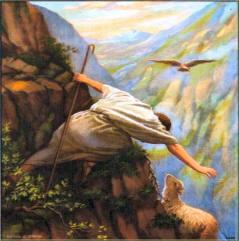
The Lost Sheep
Christ did not at this time remind His hearers of the words of Scripture. He appealed
to the witness of their own experience. The wide-spreading tablelands on the east of
Jordan afforded abundant pasturage for flocks, and through the gorges and over the wooded
hills had wandered many a lost sheep, to be searched for and brought back by the shepherd's care. In the
company about Jesus there were shepherds, and also men who had money invested in flocks
and herds, and all could appreciate His illustration: "What man of you, having
an hundred sheep, if he lose one of them, doth not leave the ninety and nine in the
wilderness, and go after that which is lost, until he find it?"
These souls whom you despise, said Jesus, are the property of God. By creation and by
redemption they are His, and they are of value in His sight. As the shepherd loves his
sheep, and cannot rest if even one be missing, so, in an infinitely higher degree, does
God love every outcast soul. Men may deny the claim of His love, they may wander from Him,
they may choose another master; yet they are God's, and He longs to recover His own. He
says, "As a shepherd seeketh out his flock in the day that he is among his sheep that
are scattered; so will I seek out My sheep, and will deliver them out of all places where
they have been scattered in the cloudy and dark day." Eze. 34:12.
In the parable the shepherd goes out to search for one sheep--the very least that can
be numbered. So if there had been but one lost soul, Christ would have died for that one.
The sheep that has strayed from the fold is the most helpless of all creatures. It must
be sought for by the shepherd, for it cannot find its way back. So with the soul that has
wandered away from God; he is as helpless as the lost sheep, and unless divine love had
come to his rescue he could never find his way to God.
The shepherd who discovers that one of his sheep is missing does not look carelessly
upon the flock that is safely housed, and say, "I have ninety and nine, and it will
cost me too much trouble to go in search of the straying one.
Let him come back, and I will open the door of the sheepfold, and let him in." No;
no sooner does the sheep go astray than the shepherd is filled with grief and anxiety. He
counts and recounts the flock. When he is sure that one sheep is lost, he slumbers not. He
leaves the ninety and nine with the fold, and goes in search of the straying sheep. The
darker and more tempestuous the night and the more perilous the way, the greater is the
shepherd's anxiety and the more earnest his search. He makes every effort to find that one
lost sheep.
With what relief he hears in the distance its first faint cry. Following the sound, he
climbs the steepest heights, he goes to the very edge of the precipice, at the risk of his
own life. Thus he searches, while the cry, growing fainter, tells him that his sheep is
ready to die. At last his effort is rewarded; the lost is found. Then he does not scold it
because it has caused him so much trouble. He does not drive it with a whip. He does not
even try to lead it home. In his joy he takes the trembling creature upon his shoulders;
if it is bruised and wounded, he gathers it in his arms, pressing it close to his bosom,
that the warmth of his own heart may give it life. With gratitude that his search has not
been in vain, he bears it back to the fold.
Thank God, He has presented to our imagination no picture of a sorrowful shepherd
returning without the sheep. The parable does not speak of failure but of success and joy
in the recovery. Here is the divine guarantee that not even one of the straying sheep of
God's fold is overlooked, not one is left unsuccored. Every one that will submit to be
ransomed, Christ will rescue from the pit of corruption and from the briers of sin.
Desponding soul, take courage, even though you have done wickedly. Do not think that perhaps
God will pardon your transgressions and permit you to come into His presence. God has made the first
advance. While you were in rebellion against Him, He went forth to seek you. With the
tender heart of the shepherd He left the ninety and nine and went out into the wilderness
to find that which was lost. The soul, bruised and wounded and ready to perish, He
encircles in His arms of love and joyfully bears it to the fold of safety.
It was taught by the Jews that before God's love is extended to the sinner, he must
first repent. In their view, repentance is a work by which men earn the favor of Heaven.
And it was this thought that led the Pharisees to exclaim in astonishment and anger.
"This man receiveth sinners." According to their ideas He should permit none to
approach Him but those who had repented. But in the parable of the lost sheep, Christ
teaches that salvation does not come through our seeking after God but through God's
seeking after us. "There is none that understandeth, there is none that seeketh after
God. They are all gone out of the way." Rom. 3:11, 12. We do not repent in order that
God may love us, but He reveals to us His love in order that we may repent.
When the straying sheep is at last brought home, the shepherd's gratitude finds
expression in melodious songs of rejoicing. He calls upon his friends and neighbors,
saying unto them, "Rejoice with me; for I have found my sheep which was lost."
So when a wanderer is found by the great Shepherd of the sheep, heaven and earth unite in
thanksgiving and rejoicing.
"Joy shall be in heaven over one sinner that repenteth, more than over ninety and
nine just persons, which need no repentance." You Pharisees, said Christ, regard
yourselves as the favorites of heaven. You think yourselves secure in your own
righteousness. Know, then, that if you need no repentance, My mission is not to you. These poor souls who feel their poverty
and sinfulness, are the very ones whom I have come to rescue. Angels of heaven are
interested in these lost ones whom you despise. You complain and sneer when one of these
souls joins himself to Me; but know that angels rejoice, and the song of triumph rings
through the courts above.
The rabbis had a saying that there is rejoicing in heaven when one who has sinned
against God is destroyed; but Jesus taught that to God the work of destruction is a
strange work. That in which all heaven delights is the restoration of God's own image in
the souls whom He has made.
When one who has wandered far in sin seeks to return to God, he will encounter
criticism and distrust. There are those who will doubt whether his repentance is genuine,
or will whisper, "He has no stability; I do not believe that he will hold out."
These persons are doing not the work of God but the work of Satan, who is the accuser of
the brethren. Through their criticisms the wicked one hopes to discourage that soul, and
to drive him still farther from hope and from God. Let the repenting sinner contemplate
the rejoicing in heaven over the return of the one that was lost. Let him rest in the love
of God and in no case be disheartened by the scorn and suspicion of the Pharisees.
The rabbis understood Christ's parable as applying to the publicans and sinners; but it
has also a wider meaning. By the lost sheep Christ represents not only the individual
sinner but the one world that has apostatized and has been ruined by sin. This world is
but an atom in the vast dominions over which God presides, yet this little fallen
world--the one lost sheep--is more precious in His sight than are the ninety and nine that
went not astray from the fold. Christ, the loved Commander in the heavenly courts,
stooped from His high estate, laid aside the glory that He had with the Father, in
order to save the one lost world. For this He left the sinless worlds on high, the ninety
and nine that loved Him, and came to this earth, to be "wounded for our
transgressions" and "bruised for our iniquities." (Isa. 53:5.) God gave
Himself in His Son that He might have the joy of receiving back the sheep that was lost.
"Behold, what manner of love the Father hath bestowed upon us, that we should be
called the sons of God." 1 John 3:1. And Christ says, "As Thou hast sent Me into
the world, even so have I also sent them into the world" (John 17:18)--to "fill
up that which is behind of the afflictions of Christ, . . . for His body's sake, which is
the church." Col. 1:24. Every soul whom Christ has rescued is called to work in His
name for the saving of the lost. This work had been neglected in Israel. Is it not
neglected today by those who profess to be Christ's followers?
How many of the wandering ones have you, reader, sought for and brought back to the
fold? When you turn from those who seem unpromising and unattractive, do you realize that
you are neglecting the souls for whom Christ is seeking? At the very time when you turn
from them, they may be in the greatest need of your compassion. In every assembly for
worship, there are souls longing for rest and peace. They may appear to be living careless
lives, but they are not insensible to the influence of the Holy Spirit. Many among them
might be won for Christ.
If the lost sheep is not brought back to the fold, it wanders until it perishes. And
many souls go down to ruin for want of a hand stretched out to save. These erring ones may
appear hard and reckless; but if they had received the same advantages that others have
had, they might have revealed far more nobility of soul, and greater talent for
usefulness. Angels pity these wandering ones. Angels weep, while human eyes are dry and
hearts are closed to pity.
O the lack of deep, soul-touching sympathy for the tempted and the erring! O for more
of Christ's spirit, and for less, far less, of self!
The Pharisees understood Christ's parable as a rebuke to them. Instead of accepting
their criticism of His work, He had reproved their neglect of the publicans and sinners.
He had not done this openly, lest it should close their hearts against Him; but His
illustration set before them the very work which God required of them, and which they had
failed to do. Had they been true shepherds, these leaders in Israel would have done the
work of a shepherd. They would have manifested the mercy and love of Christ, and would
have united with Him in His mission. Their refusal to do this had proved their claims of
piety to be false. Now many rejected Christ's reproof; yet to some His words brought
conviction. Upon these, after Christ's ascension to heaven, the Holy Spirit came, and they
united with His disciples in the very work outlined in the parable of the lost sheep.

The Lost Piece of Silver
After giving the parable of the lost sheep Christ spoke another, saying, "What
woman having ten pieces of silver, if she lose one piece, doth not light a candle, and
sweep the house, and seek diligently till she find it?"
In the East the houses of the poor usually consisted of but one room, often windowless
and dark. The room was rarely swept, and a piece of money falling on the floor would be
speedily covered by the dust and rubbish. In order that it might be found, even in the
daytime, a candle must be lighted, and the house must be swept diligently.
The wife's marriage portion usually consisted of pieces of money, which she carefully
preserved as her most cherished possession, to be transmitted to her own daughters. The
loss of one of these pieces would be regarded as a serious calamity, and its recovery
would cause great rejoicing, in which the neighboring women would readily share.
"When she hath found it," Christ said, "she calleth her friends and her
neighbors together, saying, Rejoice with me, for I have found the piece which I had lost.
Likewise, I say unto you, there is joy in the presence of the angels of God over one
sinner that repenteth."
This parable, like the preceding, sets forth the loss of something which with proper
search may be recovered, and that with great joy. But the two parables represent different
classes. The lost sheep knows that it is lost. It has left the shepherd and the flock, and
it cannot recover itself. It represents those who realize that they are separated from God
and who are in a cloud of perplexity, in humiliation, and sorely tempted. The lost coin
represents those who are lost in trespasses and sins, but who have no sense of their
condition. They are estranged from God, but they know it not. Their souls are in peril,
but they are unconscious and unconcerned. In this parable Christ teaches that even those who are indifferent to the
claims of God are the objects of His pitying love. They are to be sought for that they may
be brought back to God.
The sheep wandered away from the fold; it was lost in the wilderness or upon the
mountains. The piece of silver was lost in the house. It was close at hand, yet it could
be recovered only by diligent search.
This parable has a lesson to families. In the household there is often great
carelessness concerning the souls of its members. Among their number may be one who is
estranged from God; but how little anxiety is felt lest in the family relationship there
be lost one of God's entrusted gifts.
The coin, though lying among dust and rubbish, is a piece of silver still. Its owner
seeks it because it is of value. So every soul, however degraded by sin, is in God's sight
accounted precious. As the coin bears the image and superscription of the reigning power,
so man at his creation bore the image and superscription of God; and though now marred and
dim through the influence of sin, the traces of this inscription remain upon every soul.
God desires to recover that soul and to retrace upon it His own image in righteousness and
holiness.
The woman in the parable searches diligently for her lost coin. She lights the candle
and sweeps the house. She removes everything that might obstruct her search. Though only
one piece is lost, she will not cease her efforts until that piece is found. So in the
family if one member is lost to God every means should be used for his recovery. On the
part of all the others let there be diligent, careful self-examination. Let the
life-practice be investigated. See if there is not some mistake, some error in management,
by which that soul is confirmed in impenitence.
If there is in the family one child who is unconscious of his sinful state, parents
should not rest. Let the candle be lighted. Search the word of God, and by its light let
everything in the home be diligently examined, to see why this child is lost. Let parents
search their own hearts, examine their habits and practices. Children are the heritage of
the Lord, and we are answerable to Him for our management of His property.
There are fathers and mothers who long to labor in some foreign mission field; there
are many who are active in Christian work outside the home, while their own children are
strangers to the Saviour and His love. The work of winning their children for Christ many
parents trust to the minister or the Sabbath school teacher, but in doing this they are
neglecting their own God-given responsibility. The education and training of their
children to be Christians is the highest service that parents can render to God. It is a
work that demands patient labor, a lifelong diligent and persevering effort. By a neglect
of this trust we prove ourselves unfaithful stewards. No excuse for such neglect will be
accepted by God.
But those who have been guilty of neglect are not to despair. The woman whose coin was
lost searched until she found it. So in love, faith, and prayer let parents work for their
households, until with joy they can come to God saying, "Behold, I and the children whom the Lord hath given me." Isa. 8:18.
This is true home missionary work, and it is as helpful to those who do it as to those
for whom it is done. By our faithful interest for the home circle we are fitting ourselves
to work for the members of the Lord's family, with whom, if loyal to Christ, we shall live
through eternal ages. For our brethren and sisters in Christ we are to show the same
interest that as members of one family we have for one another.
And God designs that all this shall fit us to labor for still others. As our sympathies
shall broaden and our love increase, we shall find everywhere a work to do. God's great
human household embraces the world, and none of its members are to be passed by with
neglect.
Wherever we may be, there the lost piece of silver awaits our search. Are we seeking
for it? Day by day we meet with those who take no interest in religious things; we talk
with them, we visit among them; do we show an interest in their spiritual welfare? Do we
present Christ to them as the sin-pardoning Saviour? With our own hearts warm with the
love of Christ, do we tell them about that love? If we do not, how shall we meet these
souls--lost, eternally lost--when with them we stand before the throne of God?
The value of a soul, who can estimate? Would you know its worth, go to Gethsemane, and
there watch with Christ through those hours of anguish, when He sweat as it were great
drops of blood. Look upon the Saviour uplifted on the cross. Hear that despairing cry,
"My God, My God, why hast Thou forsaken Me?" Mark 15:34. Look upon the wounded
head, the pierced side, the marred feet. Remember that Christ risked all. For our
redemption, heaven itself was imperiled. At the foot of the cross, remembering that for
one sinner Christ would have laid down His life, you may estimate the value of a soul.
If you are in communion with Christ, you will place His estimate upon every human
being. You will feel for others the same deep love that Christ has felt for you. Then you
will be able to win, not drive, to attract, not repulse, those for whom He died. None
would ever have been brought back to God if Christ had not made a personal effort for
them; and it is by this personal work that we can rescue souls. When you see those who are
going down to death, you will not rest in quiet indifference and ease. The greater their
sin and the deeper their misery, the more earnest and tender will be your efforts for
their recovery. You will discern the need of those who are suffering, who have been
sinning against God, and who are oppressed with a burden of guilt. Your heart will go out
in sympathy for them, and you will reach out to them a helping hand. In the arms of your
faith and love you will bring them to Christ. You will watch over and encourage them, and
your sympathy and confidence will make it hard for them to fall from their steadfastness.
In this work all the angels of heaven are ready to co-operate. All the resources of
heaven are at the command of those who are seeking to save the lost. Angels will help you
to reach the most careless and the most hardened. And when one is brought back to God, all
heaven is made glad; seraphs and cherubs touch their golden harps, and sing praises to God
and the Lamb for their mercy and loving-kindness to the children of men.
|