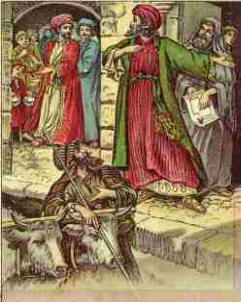
"Go into the Highways and Hedges"
[This chapter is based on Luke 14:1, 12-24.]
The Saviour was a guest at the feast of a Pharisee. He accepted invitations from the
rich as well as the poor, and according to His custom He linked the scene before Him with
His lessons of truth. Among the Jews the sacred feast was connected with all their seasons
of national and religious rejoicing. It was to them a type of the blessings of eternal
life. The great feast at which they were to sit down with Abraham, Isaac, and Jacob, while
the Gentiles stood without, and looked on with longing eyes, was a theme on which they
delighted to dwell. The lesson of warning and instruction which Christ desired to give, He
now illustrated by the parable of a great supper. The blessings of God, both for the
present and for the future life, the Jews thought to shut up to themselves. They denied
God's mercy to the Gentiles. By the parable Christ showed that they were themselves at
that very time rejecting the invitation of mercy, the call to God's kingdom.
He showed that the invitation which they had slighted was to be sent to those whom they
despised, those from whom they had drawn away their garments as if they were lepers to be
shunned.
In choosing the guests for his feast, the Pharisee had consulted his own selfish
interest. Christ said to him, "When thou makest a dinner or a supper, call not thy
friends, nor thy brethren, neither thy kinsmen, nor thy rich neighbors, lest they also bid
thee again, and a recompense be made thee. But when thou makest a feast, call the poor,
the maimed, the lame, the blind: and thou shalt be blessed; for they cannot recompense
thee: for thou shalt be recompensed at the resurrection of the just."
Christ was here repeating the instruction He had given to Israel through Moses. At
their sacred feasts the Lord had directed that "the stranger, and the fatherless, and
the widow, which are within thy gates, shall come, and shall eat, and be satisfied."
Deut. 14:29. These gatherings were to be as object lessons to Israel. Being thus taught
the joy of true hospitality, the people were throughout the year to care for the bereaved
and the poor. And these feasts had a wider lesson. The spiritual blessings given to Israel were not for themselves
alone. God had given the bread of life to them, that they might break it to the world.
This work they had not fulfilled. Christ's words were a rebuke to their selfishness. To
the Pharisees His words were distasteful. Hoping to turn the conversation into another
channel, one of them, with a sanctimonious air, exclaimed, "Blessed is he that shall
eat bread in the kingdom of God." This man spoke with great assurance, as if he
himself were certain of a place in the kingdom. His attitude was similar to the attitude
of those who rejoice that they are saved by Christ, when they do not comply with the
conditions upon which salvation is promised. His spirit was like that of Balaam when he
prayed, "Let me die the death of the righteous, and let my last end be like
his." Num. 23:10. The Pharisee was not thinking of his own fitness for heaven but of
what he hoped to enjoy in heaven. His remark was designed to turn away the minds of the
guests at the feast from the subject of their practical duty. He thought to carry them
past the present life to the remote time of the resurrection of the just.
Christ read the heart of the pretender, and fastening His eyes upon him He opened
before the company the character and value of their present privileges. He showed them
that they had a part to act at that very time, in order to share in the blessedness of the
future.
"A certain man," He said, "made a great supper, and bade many."
When the time of the feast arrived, the host sent his servant to the expected guests with
a second message, "Come; for all things are now ready." But a strange
indifference was shown. "All with one consent began to make excuse. The first said
unto him, I have bought a piece of ground, and I must needs go and see it;
I pray thee have me excused. And another said, I have bought five yoke of oxen, and I
go to prove them; I pray thee have me excused. And another said, I have married a wife,
and therefore I cannot come."
None of the excuses were founded on a real necessity. The man who "must needs go
and see" his piece of ground, had already purchased it. His haste to go and see it
was due to the fact that his interest was absorbed in his purchase. The oxen, too, had
been bought. The proving of them was only to satisfy the interest of the buyer. The third
excuse had no more semblance of reason. The fact that the intended guest had married a
wife need not have prevented his presence at the feast. His wife also would have been made
welcome. But he had his own plans for enjoyment, and these seemed to him more desirable
than the feast he had promised to attend. He had learned to find pleasure in other society
than that of the host. He did not ask to be excused, made not even a pretense of courtesy
in his refusal. The "I cannot" was only a veil for the truth--"I do not
care to come."
All the excuses betray a preoccupied mind. To these intended guests other interests had
become all-absorbing. The invitation they had pledged themselves to accept was put aside,
and the generous friend was insulted by their indifference.
By the great supper, Christ represents the blessings offered through the gospel. The
provision is nothing less than Christ Himself. He is the bread that comes down from
heaven; and from Him the streams of salvation flow. The Lord's messengers had proclaimed
to the Jews the advent of the Saviour; they had pointed to Christ as "the Lamb of
God, which taketh away the sin of the world." John 1:29. In the feast He had
provided, God offered to them the greatest gift that Heaven can bestow--a gift that is beyond computation. The
love of God had furnished the costly banquet, and had provided inexhaustible resources.
"If any man eat of this bread," Christ said, "he shall live for ever."
John 6:51.
But in order to accept the invitation to the gospel feast, they must make their worldly
interests subordinate to the one purpose of receiving Christ and His righteousness. God
gave all for man, and He asks him to place His service above every earthly and selfish
consideration. He cannot accept a divided heart. The heart that is absorbed in earthly
affections cannot be given up to God.
The lesson is for all time. We are to follow the Lamb of God whithersoever He goeth.
His guidance is to be chosen, His companionship valued above the companionship of earthly
friends. Christ says, "He that loveth father or mother more than Me is not worthy of
Me, and he that loveth son or daughter more than Me is not worthy of Me." Matt.
10:37.
Around the family board, when breaking their daily bread, many in Christ's day repeated
the words, "Blessed is he that shall eat bread in the kingdom of God." But
Christ showed how difficult it was to find guests for the table provided at infinite cost.
Those who listened to His words knew that they had slighted the invitation of mercy. To
them worldly possessions, riches, and pleasures were all-absorbing. With one consent they had made excuse.
So it is now. The excuses urged for refusing the invitation to the feast cover the
whole ground of excuses for refusing the gospel invitation. Men declare that they cannot
imperil their worldly prospects by giving attention to the claims of the gospel. They
count their temporal interests as of more value than the things of eternity. The very
blessings they have received from God become a barrier to separate their souls from their
Creator and Redeemer. They will not be interrupted in their worldly pursuits, and they say
to the messenger of mercy, "Go thy way for this time; when I have a convenient
season, I will call for thee." Acts 24:25. Others urge the difficulties that would
arise in their social relations should they obey the call of God. They say they cannot
afford to be out of harmony with their relatives and acquaintances. Thus they prove
themselves to be the very actors described in the parable. The Master of the feast regards
their flimsy excuses as showing contempt for His invitation.
The man who said, "I have married a wife, and therefore I cannot come,"
represents a large class. Many there are who allow their wives or their husbands to
prevent them from heeding the call of God. The husband says, "I cannot obey my
convictions of duty while my wife is opposed to it. Her influence would make it
exceedingly hard for me to do so." The wife hears the gracious call, "Come; for
all things are now ready," and she says, "'I pray thee have me excused.' My
husband refuses the invitation of mercy. He says that his business stands in the way. I
must go with my husband, and therefore I cannot come." The children's hearts are
impressed. They desire to come. But they love their father and mother, and since these do
not heed the gospel call, the children think that they cannot be expected to come. They too say, "Have me excused."
All these refuse the Saviour's call because they fear division in the family circle.
They suppose that in refusing to obey God they are insuring the peace and prosperity of
the home; but this is a delusion. Those who sow selfishness will reap selfishness. In
rejecting the love of Christ they reject that which alone can impart purity and
steadfastness to human love. They will not only lose heaven, but will fail of the true
enjoyment of that for which heaven was sacrificed.
In the parable, the giver of the feast learned how his invitation had been treated, and
"being angry, said to his servant, Go out quickly into the streets and lanes of the
city, and bring in hither the poor, and the maimed, and the halt, and the blind."
The host turned from those who despised his bounty, and invited a class who were not
full, who were not in possession of houses and lands. He invited those who were
poor and hungry, and who would appreciate the bounties provided. "The publicans
and the harlots," Christ said, "go into the kingdom of God before you."
Matt. 21:31. However wretched may be the specimens of humanity that men spurn and turn
aside from, they are not too low, too wretched, for the notice and love of God. Christ
longs to have care-worn, weary, oppressed human beings come to Him. He longs to give them
the light and joy and peace that are to be found nowhere else. The veriest sinners are the
objects of His deep, earnest pity and love. He sends His Holy Spirit to yearn over them
with tenderness, seeking to draw them to Himself.
The servant who brought in the poor and the blind reported to his master, "It is
done as thou hast commanded, and yet there is room. And the Lord said unto the servant, Go
out into the highways and hedges, and compel them to come in, that my house may be
filled." Here Christ pointed to the work of the gospel outside the pale of Judaism,
in the highways and byways of the world.
In obedience to this command, Paul and Barnabas declared to the Jews, "It was
necessary that the word of God should first have been spoken to you; but seeing ye put it
from you, and judge yourselves unworthy of everlasting life, lo, we turn to the Gentiles.
For so hath the Lord commanded us, saying, I have set Thee to be a light of the Gentiles,
that Thou shouldest be for salvation unto the ends of the earth. And when the Gentiles
heard this, they were glad, and glorified the word of the Lord; and as many as were
ordained to eternal life believed." Acts 13:46-48.
The gospel message proclaimed by Christ's disciples was the announcement of His first
advent to the world. It bore to men the good tidings of salvation through faith in Him. It
pointed forward to His second coming in glory to redeem His people, and it set before men the hope, through faith and obedience, of sharing the
inheritance of the saints in light. This message is given to men today, and at this time
there is coupled with it the announcement of Christ's second coming as at hand. The signs
which He Himself gave of His coming have been fulfilled, and by the teaching of God's word
we may know that the Lord is at the door.
John in the Revelation foretells the proclamation of the gospel message just before
Christ's second coming. He beholds an angel flying "in the midst of heaven, having
the everlasting gospel to preach unto them that dwell on the earth, and to every nation,
and kindred, and tongue, and people, saying with a loud voice, Fear God, and give glory to
Him; for the hour of His judgment is come." Rev. 14:6,7.
In the prophecy this warning of the judgment, with its connected messages, is followed
by the coming of the Son of man in the clouds of heaven. The proclamation of the judgment
is an announcement of Christ's second coming as at hand. And this proclamation is called
the everlasting gospel. Thus the preaching of Christ's second coming, the announcement of its nearness, is shown to be an essential part of the
gospel message.
The Bible declares that in the last days men will be absorbed in worldly pursuits, in
pleasure and money-getting. They will be blind to eternal realities. Christ says, "As
the days of Noah were, so shall also the coming of the Son of man be. For as in the days
that were before the flood they were eating and drinking, marrying and giving in marriage,
until the day that Noah entered into the ark, and knew not until the flood came, and took
them all away; so shall also the coming of the Son of man be." Matt. 24:37-39.
So it is today. Men are rushing on in the chase for gain and selfish indulgence as if
there were no God, no heaven, and no hereafter. In Noah's day the warning of the flood was
sent to startle men in their wickedness and call them to repentance. So the message of
Christ's soon coming is designed to arouse men from their absorption in worldly things. It
is intended to awaken them to a sense of eternal realities, that they may give heed to the
invitation to the Lord's table.
The gospel invitation is to be given to all the world--"to every nation, and
kindred, and tongue, and people." Rev. 14:6. The last message of warning and mercy is
to lighten the whole earth with its glory. It is to reach all classes of men, rich and
poor, high and low. "Go out into the highways and hedges," Christ says,
"and compel them to come in, that My house may be filled."
The world is perishing for want of the gospel. There is a famine for the word of God.
There are few who preach the word unmixed with human tradition. Though men have the Bible
in their hands, they do not receive the blessing that God has placed in it for them. The
Lord calls upon His servants to carry His message to the people. The word of everlasting life must be given to those who are perishing in their sins.
In the command to go into the highways and hedges, Christ sets forth the work of all
whom He calls to minister in His name. The whole world is the field for Christ's
ministers. The whole human family is comprised in their congregation. The Lord desires
that His word of grace shall be brought home to every soul.
To a great degree this must be accomplished by personal labor. This was Christ's
method. His work was largely made up of personal interviews. He had a faithful regard for
the one-soul audience. Through that one soul the message was often extended to thousands.
We are not to wait for souls to come to us; we must seek them out where they are. When
the word has been preached in the pulpit, the work has but just begun. There are
multitudes who will never be reached by the gospel unless it is carried to them.
The invitation to the feast was first given to the Jewish people, the people who had
been called to stand as teachers and leaders among men, the people in whose hands were the
prophetic scrolls foretelling Christ's advent, and to whom was committed the symbolic
service foreshadowing His mission. Had priests and people heeded the call, they would have
united with Christ's messengers in giving the gospel invitation to the world. The truth
was sent to them that they might impart it. When they refused the call, it was sent to the
poor, the maimed, the halt, and the blind. Publicans and sinners received the invitation.
When the gospel call is sent to the Gentiles, there is the same plan of working. The
message is first to be given "in the highways"--to men who have an active part
in the world's work, to the teachers and leaders of the people.
Let the Lord's messengers bear this in mind. To the shepherds of the flock, the
teachers divinely appointed, it should come as a word to be heeded. Those who belong to
the higher ranks of society are to be sought out with tender affection and brotherly
regard. Men in business life, in high positions of trust, men with large inventive
faculties and scientific insight, men of genius, teachers of the gospel whose minds have
not been called to the special truths for this time--these should be the first to hear the
call. To them the invitation must be given.
There is a work to be done for the wealthy. They need to be awakened to their
responsibility as those entrusted with the gifts of heaven. They need to be reminded that
they must give an account to Him who shall judge the living and the dead. The wealthy man
needs your labor in the love and fear of God. Too often he trusts in his riches, and feels
not his danger. The eyes of his mind need to be attracted to things of enduring value. He
needs to recognize the authority of true goodness, which says, "Come unto Me, all ye
that labour and are heavy laden, and I will give you rest. Take My yoke upon you, and
learn of Me; for I am meek and lowly in heart, and ye shall find rest unto your souls; for
My yoke is easy, and My burden is light." Matt. 11:28-30.
Those who stand high in the world for their education, wealth, or calling, are seldom
addressed personally in regard to the interests of the soul. Many Christian workers
hesitate to approach these classes. But this should not be. If a man were drowning, we
would not stand by and see him perish because he was a lawyer, a merchant, or a judge. If
we saw persons rushing over a precipice, we would not hesitate to urge them back, whatever
might be their position or calling. Neither should we hesitate to warn men of the peril of
the soul.
None should be neglected because of their apparent devotion to worldly things. Many in
high social positions are heartsore, and sick of vanity. They are longing for a peace
which they have not. In the very highest ranks of society are those who are hungering and
thirsting for salvation. Many would receive help if the Lord's workers would approach them
personally, with a kind manner, a heart made tender by the love of Christ.
The success of the gospel message does not depend upon learned speeches, eloquent
testimonies, or deep arguments. It depends upon the simplicity of the message and its
adaptation to the souls that are hungering for the bread of life. "What shall I do to
be saved?"--this is the want of the soul.
Thousands can be reached in the most simple and humble way. The most intellectual,
those who are looked upon as the world's most gifted men and women, are often refreshed by
the simple words of one who loves God, and who can speak of that love as naturally as the
worldling speaks of the things that interest him most deeply.
Often the words well prepared and studied have but little influence. But the true,
honest expression of a son or daughter of God, spoken in natural simplicity, has power to
unbolt the door to hearts that have long been closed against Christ and His love.
Let the worker for Christ remember that he is not to labor in his own strength. Let him
lay hold of the throne of God with faith in His power to save. Let him wrestle with God in
prayer, and then work with all the facilities God has given him. The Holy Spirit is
provided as his efficiency. Ministering angels will be by his side to impress hearts.
If the leaders and teachers at Jerusalem had received the truth Christ brought, what a
missionary center their city would have been! Backslidden Israel would have been
converted. A vast army would have been gathered for the Lord. And how rapidly they could
have carried the gospel to all parts of the world. So now, if men of influence and large
capacity for usefulness could be won for Christ, then through them what a work could be
accomplished in lifting up the fallen, gathering in the outcasts, and spreading far and
wide the tidings of salvation. Rapidly the invitation might be given, and the guests be
gathered for the Lord's table.
But we are not to think only of great and gifted men, to the neglect of the poorer
classes. Christ instructs His messengers to go also to those in the byways and hedges, to
the poor and lowly of the earth. In the courts and lanes of the great cities, in the
lonely byways of the country, are families and individuals--perhaps strangers in a strange land--who are without
church relations, and who, in their loneliness, come to feel that God has forgotten them.
They do not understand what they must do to be saved. Many are sunken in sin. Many are in
distress. They are pressed with suffering, want, unbelief, despondency. Disease of every
type afflicts them, both in body and in soul. They long to find a solace for their
troubles, and Satan tempts them to seek it in lusts and pleasures that lead to ruin and
death. He is offering them the apples of Sodom, that will turn to ashes upon their lips.
They are spending their money for that which is not bread and their labor for that which
satisfieth not.
In these suffering ones we are to see those whom Christ came to save. His invitation to
them is "Ho, every one that thirsteth, come ye to the waters, and he that hath no
money; come ye, buy and eat; yea, come, buy wine and milk without money and without price.
. . . Hearken diligently unto Me, and eat ye that which is good, and let your soul delight
itself in fatness. Incline your ear, and come unto Me: hear, and your soul shall
live." Isa. 55:1-3.
God has given a special command that we should regard the stranger, the outcast, and
the poor souls who are weak in moral power. Many who appear wholly indifferent to
religious things are in heart longing for rest and peace. Although they may have sunken to
the very depths of sin, there is a possibility of saving them.
Christ's servants are to follow His example. As He went from place to place, He
comforted the suffering and healed the sick. Then He placed before them the great truths
in regard to His kingdom. This is the work of His followers. As you relieve the sufferings
of the body, you will find ways for ministering to the wants of the soul. You can point to
the uplifted Saviour, and tell of the love of the great Physician, who alone has power to restore.
Tell the poor desponding ones who have gone astray that they need not despair. Though
they have erred, and have not been building a right character, God has joy to restore
them, even the joy of His salvation. He delights to take apparently hopeless material,
those through whom Satan has worked, and make them the subjects of His grace. He rejoices
to deliver them from the wrath which is to fall upon the disobedient. Tell them there is
healing, cleansing for every soul. There is a place for them at the Lord's table. He is
waiting to bid them welcome.
Those who go into the byways and hedges will find others of a widely different
character, who need their ministry. There are those who are living up to all the light
they have, and are serving God the best they know how. But they realize that there is a
great work to be done for themselves and for those about them. They are longing for an
increased knowledge of God, but they have only begun to see the glimmering of greater
light. They are praying with tears that God will send them the blessing which by faith
they discern afar off. In the midst of the wickedness of the great cities many of these
souls are to be found. Many of them are in very humble circumstances, and because of this
they are unnoticed by the world. There are many of whom ministers and churches know
nothing. But in lowly, miserable places they are the Lord's witnesses. They may have had
little light and few opportunities for Christian training, but in the midst of nakedness,
hunger, and cold they are seeking to minister to others. Let the stewards of the manifold
grace of God seek out these souls, visit their homes, and through the power of the Holy
Spirit minister to their needs. Study the Bible with them and pray with them with that
simplicity which the Holy Spirit inspires. Christ will give His servants a message that
will be as the bread of heaven to the soul. The precious blessing will be carried from heart to
heart, from family to family.
The command given in the parable, to "compel them to come in," has often been
misinterpreted. It has been regarded as teaching that we should force men to receive the
gospel. But it denotes rather the urgency of the invitation, and the effectiveness of the
inducements presented. The gospel never employs force in bringing men to Christ. Its
message is "Ho, every one that thirsteth, come ye to the waters." Isa. 55:1.
"The Spirit and the bride say, Come. . . . And whosoever will, let him take the water
of life freely." Rev. 22:17. The power of God's love and grace constrains us to come.
The Saviour says, "Behold, I stand at the door, and knock; if any man hear My
voice, and open the door, I will come in to him, and will sup with him, and he with
Me." Rev. 3:20. He is not repulsed by scorn or turned aside by threatening, but
continually seeks the lost ones, saying, "How shall I give thee up?" Hosea 11:8.
Although His love is driven back by the stubborn heart, He returns to plead with greater
force, "Behold, I stand at the door, and knock." The winning power of His love
compels souls to come in. And to Christ they say, "Thy gentleness hath made me
great." Ps. 18:35.
Christ will impart to His messengers the same yearning love that He Himself has in
seeking for the lost. We are not merely to say, "Come." There are those who hear
the call, but their ears are too dull to take in its meaning. Their eyes are too blind to
see anything good in store for them. Many realize their great degradation. They say, I am
not fit to be helped; leave me alone. But the workers must not desist. In tender, pitying
love, lay hold of the discouraged and helpless ones. Give them your courage, your hope,
your strength. By kindness compel them to come. "Of some have compassion, making a difference; and others save with fear,
pulling them out of the fire." Jude 22, 23.
If the servants of God will walk with Him in faith, He will give power to their
message. They will be enabled so to present His love and the danger of rejecting the grace
of God that men will be constrained to accept the gospel. Christ will perform wonderful
miracles if men will but do their God-given part. In human hearts today as great a
transformation may be wrought as has ever been wrought in generations past. John Bunyan
was redeemed from profanity and reveling, John Newton from slave dealing, to proclaim an
uplifted Saviour. A Bunyan and a Newton may be redeemed from among men today. Through
human agents who co-operate with the divine, many a poor outcast will be reclaimed, and in
his turn will seek to restore the image of God in man. There are those who have had very
meager opportunities, who have walked in ways of error because they knew no better way, to
whom beams of light will come. As the word of Christ came to Zacchaeus, "Today I must
abide at thy house" (Luke 19:5), so the word will come to them; and those who were
supposed to be hardened sinners will be found to have hearts as tender as a child's
because Christ has deigned to notice them. Many will come from the grossest error and sin,
and will take the place of others who have had opportunities and privileges but have not
prized them. They will be accounted the chosen of God, elect, precious; and when Christ
shall come into His kingdom, they will stand next His throne.
But "see that ye refuse not Him that speaketh." Heb. 12:25. Jesus said,
"None of those men which were bidden shall taste of My supper." They had
rejected the invitation, and none of them were to be invited again. In rejecting Christ,
the Jews were hardening their hearts, and giving themselves into the power of Satan so
that it would be impossible for them to accept His grace. So it is now. If the love of God is
not appreciated and does not become an abiding principle to soften and subdue the soul, we
are utterly lost. The Lord can give no greater manifestation of His love than He has
given. If the love of Jesus does not subdue the heart, there are no means by which we can
be reached.
Every time you refuse to listen to the message of mercy, you strengthen yourself in
unbelief. Every time you fail to open the door of your heart to Christ, you become more
and more unwilling to listen to the voice of Him that speaketh. You diminish your chance
of responding to the last appeal of mercy. Let it not be written of you, as of ancient
Israel, "Ephraim is joined to idols; let him alone." Hosea 4:17. Let not Christ
weep over you as He wept over Jerusalem, saying, "How often would I have gathered thy
children together, as a hen doth gather her brood under her wings, and ye would not!
Behold, your house is left unto you desolate." Luke 13:34, 35.
We are living in a time when the last message of mercy, the last invitation, is
sounding to the children of men. The command, "Go out into the highways and
hedges," is reaching its final fulfillment. To every soul Christ's invitation will be
given. The messengers are saying, "Come; for all things are now ready." Heavenly
angels are still working in co-operation with human agencies. The Holy Spirit is
presenting every inducement to constrain you to come. Christ is watching for some sign
that will betoken the removing of the bolts and the opening of the door of your heart for
His entrance. Angels are waiting to bear the tidings to heaven that another lost sinner
has been found. The hosts of heaven are waiting, ready to strike their harps and to sing a
song of rejoicing that another soul has accepted the invitation to the gospel feast.
|